#include <inttypes.h>#include <stdarg.h>#include <stdbool.h>#include <stddef.h>#include <stdint.h>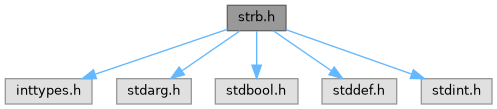
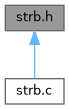
Go to the source code of this file.
Classes | |
| struct | strbstate_t |
| String buffer state. More... | |
Macros | |
| #define | STRB_EXT_STATE 1 |
| #define | STRB_UNPUTC 1 |
| #define | STRB_RESTORE 1 |
| #define | STRB_REUSE_CONST 1 |
| #define | STRB_SIZE_HINT(X) static restrict X |
| #define | STRB_MAX SIZE_MAX |
| #define | PRIstrbsize PRIu16 |
| #define | STRB_MAX_SIZE UINT16_MAX |
| #define | STRB_DFL_SIZE (256) |
| #define | STRB_MAX_INTERNAL_SIZE (256) |
| #define | STRB_GROW_FACTOR (2) |
| #define | _Optional |
| #define | strb_wrote(sb) strb_restore(sb) |
Typedefs | |
| typedef uint16_t | strbsize_t |
| typedef struct strb_t | strb_t |
| String buffer object. | |
Enumerations | |
| enum | { strb_insert , strb_overwrite } |
| Editing mode. More... | |
Functions | |
| strb_t * | strb_use (strbstate_t *restrict sbs, size_t size, char buf[STRB_SIZE_HINT(size)]) |
| Create a string buffer object for managing an external character array. | |
| _Optional strb_t * | strb_reuse (strbstate_t *restrict sbs, size_t size, char buf[STRB_SIZE_HINT(size)]) |
| Create a string buffer object by reusing an external character array. | |
| _Optional const strb_t * | strb_reuse_const (strbstate_t *restrict sbs, const char buf[STRB_SIZE_HINT(1)]) |
| Create a string buffer object that wraps a constant string. | |
| _Optional strb_t * | strb_alloc (size_t n) |
| Create a string buffer object with internal storage. | |
| _Optional strb_t * | strb_dup (const char *str) |
| Create a string buffer object with internal storage by duplicating a string. | |
| _Optional strb_t * | strb_ndup (const char *str, size_t n) |
| Create a string buffer object with internal storage by duplicating a sequence of characters. | |
| _Optional strb_t * | strb_aprintf (const char *restrict format,...) |
| Create a string buffer object with internal storage by parsing a format string. | |
| _Optional strb_t * | strb_vaprintf (const char *restrict format, va_list args) |
| Create a string buffer object with internal storage by parsing a format string. | |
| void | strb_free (_Optional strb_t *sb) |
| Destroy a string buffer object. | |
| char * | strb_ptr (strb_t *sb) |
| Get a pointer to the character array underlying a string buffer. | |
| const char * | strb_cptr (strb_t const *sb) |
| size_t | strb_len (strb_t const *sb) |
| Get the number of characters stored in a string buffer. | |
| int | strb_setmode (strb_t *sb, int mode) |
| Set the editing mode of a string buffer. | |
| int | strb_getmode (const strb_t *sb) |
| Get the editing mode of a string buffer. | |
| int | strb_seek (strb_t *sb, size_t pos) |
| Set the editing position of a string buffer. | |
| size_t | strb_tell (strb_t const *sb) |
| Get the editing position of a string buffer. | |
| int | strb_putc (strb_t *sb, int c) |
| Put a character into a string buffer. | |
| int | strb_nputc (strb_t *sb, int c, size_t n) |
| Put a character into a string buffer multiple times. | |
| int | strb_unputc (strb_t *sb) |
| Undo the last put character operation. | |
| int | strb_puts (strb_t *restrict sb, const char *restrict str) |
| Put a string into a string buffer. | |
| int | strb_nputs (strb_t *restrict sb, const char *restrict str, size_t n) |
| Put a sequence of characters into a string buffer. | |
| int | strb_vputf (strb_t *restrict sb, const char *restrict format, va_list args) |
| Put a generated string into a string buffer. | |
| int | strb_putf (strb_t *restrict sb, const char *restrict format,...) |
| Put a generated string into a string buffer. | |
| _Optional char * | strb_write (strb_t *sb, size_t n) |
| Prepare to write characters directly into a string buffer. | |
| void | strb_split (strb_t *sb) |
| Split a string at the current position. | |
| void | strb_restore (strb_t *sb) |
| Restore a character that may have been overwritten by a preceding write. | |
| void | strb_delto (strb_t *sb, size_t pos) |
| Delete characters to a specified position in a string buffer. | |
| int | strb_cpy (strb_t *restrict sb, const char *restrict str) |
| Copy a string into a string buffer. | |
| int | strb_ncpy (strb_t *restrict sb, const char *restrict str, size_t n) |
| Copy a sequence of characters into a string buffer. | |
| int | strb_vprintf (strb_t *restrict sb, const char *restrict format, va_list args) |
| Print a generated string into a string buffer. | |
| int | strb_printf (strb_t *restrict sb, const char *restrict format,...) |
| Print a generated string into a string buffer. | |
| bool | strb_error (strb_t const *sb) |
| Get the error indicator of a string buffer. | |
| void | strb_clearerr (strb_t *sb) |
| Clear the error indicator of a string buffer. | |
Detailed Description
Macro Definition Documentation
◆ _Optional
◆ PRIstrbsize
| #define PRIstrbsize PRIu16 |
Macro to be used to print values of type strbsize_t
◆ STRB_DFL_SIZE
| #define STRB_DFL_SIZE (256) |
Buffer size, in characters, substituted by strb_alloc when the requested size is too small.
◆ STRB_EXT_STATE
| #define STRB_EXT_STATE 1 |
◆ STRB_GROW_FACTOR
| #define STRB_GROW_FACTOR (2) |
◆ STRB_MAX
| #define STRB_MAX SIZE_MAX |
◆ STRB_MAX_INTERNAL_SIZE
| #define STRB_MAX_INTERNAL_SIZE (256) |
◆ STRB_MAX_SIZE
| #define STRB_MAX_SIZE UINT16_MAX |
◆ STRB_RESTORE
| #define STRB_RESTORE 1 |
Whether the interface provides the strb_restore function.
◆ STRB_REUSE_CONST
| #define STRB_REUSE_CONST 1 |
Whether the interface provides the strb_reuse_const function.
◆ STRB_SIZE_HINT
| #define STRB_SIZE_HINT | ( | X | ) | static restrict X |
◆ STRB_UNPUTC
| #define STRB_UNPUTC 1 |
Whether the interface provides the strb_unputc function.
◆ strb_wrote
| #define strb_wrote | ( | sb | ) | strb_restore(sb) |
- Deprecated:
- Original name of strb_restore.
Typedef Documentation
◆ strb_t
String buffer object.
An object type to be used in place of strbstate_t for all operations on a string buffer. It need not be a complete type. Consequently, it may be impossible to wrongly declare an object of type strb_t and its internal state should only be accessed by the provided functions.
◆ strbsize_t
| typedef uint16_t strbsize_t |
Enumeration Type Documentation
◆ anonymous enum
| anonymous enum |
Editing mode.
Function Documentation
◆ strb_alloc()
| _Optional strb_t * strb_alloc | ( | size_t | n | ) |
Create a string buffer object with internal storage.
Allocates storage for a string buffer object, initialises it, and returns its address. If storage allocation fails, a null pointer is returned.
The initial string length is 0. This function does not necessarily allocate storage for a string immediately, providing that all other functions operate as if it had been allocated. Subsequent operations on the string buffer may allocate or free extra storage, if supported by the implementation.
- Parameters
-
n A hint about how much storage to allocate for an internal buffer (where 0 means default size). Measured in characters not bytes, excluding the terminating null character.
- Returns
- Address of the created string buffer object, or a null pointer on failure.
- Postcondition
- The user is responsible for calling strb_free to free the string buffer object.
- If successful, strb_tell and strb_len return 0.
- If successful, a call to strb_restore will have no effect until strb_write has been called.
- If successful, a call to strb_error will return false until an error occurs.
◆ strb_aprintf()
| _Optional strb_t * strb_aprintf | ( | const char *restrict | format, |
| ... | |||
| ) |
Create a string buffer object with internal storage by parsing a format string.
Allocates storage for a string buffer object, initialises it, and returns its address. If storage allocation fails, a null pointer is returned.
The format parameter specifies how to convert subsequent arguments to generate a string, which forms the initial content of the buffer. Subsequent operations on the buffer may automatically allocate or free extra storage, if supported by the implementation.
- Parameters
-
[in] format Specifies how to convert subsequent arguments to generate a string. ... Arguments to be substituted into the generated string.
- Returns
- Address of the created string buffer object, or a null pointer on failure.
- Postcondition
- The user is responsible for calling strb_free to free the string buffer object.
- If successful, strb_tell and strb_len return the number of characters generated.
- If successful, the last character generated (if any) can be removed by strb_unputc.
- If successful, a call to strb_restore will have no effect until strb_write has been called.
- If successful, a call to strb_error will return false until an error occurs.
◆ strb_clearerr()
| void strb_clearerr | ( | strb_t * | sb | ) |
Clear the error indicator of a string buffer.
- Parameters
-
[in,out] sb String buffer.
- Precondition
- The given
sbaddress was returned by strb_use, strb_reuse, strb_alloc, strb_dup, strb_ndup, strb_aprintf or strb_vaprintf.
- Postcondition
- A call to strb_error will return false until an error occurs.
◆ strb_cptr()
◆ strb_cpy()
| int strb_cpy | ( | strb_t *restrict | sb, |
| const char *restrict | str | ||
| ) |
Copy a string into a string buffer.
Replaces the string in a buffer by copying a string.
- Parameters
-
[in,out] sb String buffer. [in] str A string to be copied as the new content of the buffer.
- Returns
- Zero if successful, otherwise EOF.
- Precondition
- The given
sbaddress was returned by strb_use, strb_reuse, strb_alloc, strb_dup, strb_ndup, strb_aprintf or strb_vaprintf.
- Postcondition
- If successful, strb_tell and strb_len return the number of characters copied.
- If successful, the last character copied (if any) can be removed by strb_unputc.
- If successful, a call to strb_restore will have no effect until strb_write has been called.
- On failure, a call to strb_error will return true until strb_clearerr has been called.
◆ strb_delto()
| void strb_delto | ( | strb_t * | sb, |
| size_t | pos | ||
| ) |
Delete characters to a specified position in a string buffer.
Deletes characters between the current position and a position specified by the caller. If the mode is strb_insert, then the character at the higher of the two positions is moved to the lower position, and any following characters are moved the same distance; otherwise, no characters are moved. Afterwards, the value of the position indicator is the lower of the two positions. This function may substitute a smaller buffer at the implementer's discretion.
Passing a position greater than the string length is allowed: SIZE_MAX or (size_t)-1 can be used as a shorthand to delete all characters between the current position and the end of the string.
- Parameters
-
[in,out] sb String buffer. pos New position, in characters.
- Precondition
- The given
sbaddress was returned by strb_use, strb_reuse, strb_alloc, strb_dup, strb_ndup, strb_aprintf or strb_vaprintf.
- Postcondition
- The position indicator is at the lower of
posand the previous position and the string length has decreased by not more than the difference between the two. - A call to strb_restore will have no effect until strb_write has been called.
◆ strb_dup()
| _Optional strb_t * strb_dup | ( | const char * | str | ) |
Create a string buffer object with internal storage by duplicating a string.
Allocates storage for a string buffer object, initialises it, and returns its address. If storage allocation fails, a null pointer is returned.
Copies the given string into internal storage, including its null terminator. Subsequent operations on the string buffer may automatically allocate or free extra storage, if supported by the implementation.
- Parameters
-
[in] str A string to be copied as the initial content of the buffer.
- Returns
- Address of the created string buffer object, or a null pointer on failure.
- Postcondition
- The user is responsible for calling strb_free to free the string buffer object.
- If successful, strb_tell and strb_len return the number of characters copied.
- If successful, the last character copied (if any) can be removed by strb_unputc.
- If successful, a call to strb_restore will have no effect until strb_write has been called.
- If successful, a call to strb_error will return false until an error occurs.
◆ strb_error()
| bool strb_error | ( | strb_t const * | sb | ) |
Get the error indicator of a string buffer.
Additional storage for the underlying character array may be allocated automatically as the string grows, for example because of calls to strb_puts. When using a character array passed to strb_use or strb_reuse, or an internal buffer of fixed size, any attempt to allocate more storage fails. If any attempt at storage allocation fails, the state of the buffer, mode, and position indicator are as if the failed operation had never been attempted. This allows use in interactive software running on machines with limited physical memory and no swap file.
An error indicator is stored to allow deferred error handling. Its value can be read at any time by calling strb_error. An error can only be cleared explicitly (by calling strb_clearerr). The error indicator is set as a side-effect of any function that returns an error value, including because of attempts to reposition to an unsupported index or select an unsupported editing mode. Consequently, it is a reliable indication of whether the current string is valid.
- Parameters
-
[in] sb String buffer.
- Returns
- True if an error occurred since the most recent call to strb_clearerr, otherwise false.
- Precondition
- The given
sbaddress was returned by strb_use, strb_reuse, strb_alloc, strb_dup, strb_ndup, strb_aprintf or strb_vaprintf.
◆ strb_free()
| void strb_free | ( | _Optional strb_t * | sb | ) |
Destroy a string buffer object.
The associated buffer is also automatically freed, except in the case where its address was passed as a parameter to strb_use or strb_reuse. This must be enforced because storage allocation is abstracted. To pass an internally allocated string to code that needs to take ownership of it, it must first be copied (e.g., using strdup).
May be called with a null pointer, in which case this function has no effect.
- Parameters
-
[in] sb String buffer to destroy, or a null pointer.
- Precondition
- The given
sbaddress is null or was returned by strb_use, strb_reuse, strb_alloc, strb_dup, strb_ndup, strb_aprintf or strb_vaprintf.
- Postcondition
sbis invalid for use with any function.
◆ strb_getmode()
| int strb_getmode | ( | const strb_t * | sb | ) |
Get the editing mode of a string buffer.
- Parameters
-
[in] sb String buffer.
- Returns
- Current editing mode.
- Precondition
- The given
sbaddress was returned by strb_use, strb_reuse, strb_alloc, strb_dup, strb_ndup, strb_aprintf or strb_vaprintf.
- Postcondition
- The returned value may be passed to strb_setmode.
◆ strb_len()
| size_t strb_len | ( | strb_t const * | sb | ) |
Get the number of characters stored in a string buffer.
A null character may appear anywhere in string buffer, since it is easy to insert one by calling strb_putf(sb, "%c", 0). It would be hard to prevent such misuse. Consequently, strb_len(sb) and strlen(strb_ptr(sb)) can return different results. The returned length is never less than, but may be greater than, the true string length.
- Parameters
-
[in] sb String buffer.
- Returns
- Number of characters stored in the string buffer.
- Precondition
- The given
sbaddress was returned by strb_use, strb_reuse, strb_alloc, strb_dup, strb_ndup, strb_aprintf or strb_vaprintf.
◆ strb_ncpy()
| int strb_ncpy | ( | strb_t *restrict | sb, |
| const char *restrict | str, | ||
| size_t | n | ||
| ) |
Copy a sequence of characters into a string buffer.
Replaces the string in a buffer by copying up to n characters from the array designated by str, then appends a null terminator. A null character and any characters following it are not copied.
- Parameters
-
[in,out] sb String buffer. [in] str An array of characters to be copied as the new content of the buffer. n Maximum number of characters to copy from str.
- Returns
- Zero if successful, otherwise EOF.
- Precondition
- The given
sbaddress was returned by strb_use, strb_reuse, strb_alloc, strb_dup, strb_ndup, strb_aprintf or strb_vaprintf.
- Postcondition
- If successful, strb_tell and strb_len return the number of characters copied.
- If successful, the last character copied (if any) can be removed by strb_unputc.
- If successful, a call to strb_restore will have no effect until strb_write has been called.
- On failure, a call to strb_error will return true until strb_clearerr has been called.
◆ strb_ndup()
| _Optional strb_t * strb_ndup | ( | const char * | str, |
| size_t | n | ||
| ) |
Create a string buffer object with internal storage by duplicating a sequence of characters.
Allocates storage for a string buffer object, initialises it, and returns its address. If storage allocation fails, a null pointer is returned.
Copies up to n characters from the array designated by str into internal storage, then appends a null terminator. A null character and any characters following it are not copied. Subsequent operations on the string buffer may automatically allocate or free extra storage, if supported by the implementation.
- Parameters
-
[in] str An array of characters to be copied as the initial content of the buffer. n Maximum number of characters to copy from str.
- Returns
- Address of the created string buffer object, or a null pointer on failure.
- Postcondition
- The user is responsible for calling strb_free to free the string buffer object.
- If successful, strb_tell and strb_len return the number of characters copied.
- If successful, the last character copied (if any) can be removed by strb_unputc.
- If successful, a call to strb_restore will have no effect until strb_write has been called.
- If successful, a call to strb_error will return false until an error occurs.
◆ strb_nputc()
| int strb_nputc | ( | strb_t * | sb, |
| int | c, | ||
| size_t | n | ||
| ) |
Put a character into a string buffer multiple times.
Equivalent to calling strb_putc n times with the given value of c.
- Parameters
-
[in,out] sb String buffer. c Character to put. n The number of times to copy the specified character into the buffer.
- Returns
- If successful, the character written, otherwise EOF.
- Precondition
- The given
sbaddress was returned by strb_use, strb_reuse, strb_alloc, strb_dup, strb_ndup, strb_aprintf or strb_vaprintf.
- Postcondition
- If successful, the position indicator has advanced by
ncharacters and the string length has increased by not more thann(depending on editing position and mode). - If successful, the last character written can be removed by strb_unputc.
- If successful, a call to strb_restore will have no effect until strb_write has been called.
- On failure, a call to strb_error will return true until strb_clearerr has been called.
◆ strb_nputs()
| int strb_nputs | ( | strb_t *restrict | sb, |
| const char *restrict | str, | ||
| size_t | n | ||
| ) |
Put a sequence of characters into a string buffer.
Copies up to n characters from the array designated by str into the buffer at the current position as if by calling strb_putc for each character. A null character and any characters following it are not copied.
- Parameters
-
[in,out] sb String buffer. [in] str A string to be copied into the buffer. n Maximum number of characters to copy from str.
- Returns
- Zero if successful, otherwise EOF. (This is stricter than
fputs, which returns only 'a nonnegative value' if successful.)
- Precondition
- The given
sbaddress was returned by strb_use, strb_reuse, strb_alloc, strb_dup, strb_ndup, strb_aprintf or strb_vaprintf.
- Postcondition
- If successful, the position indicator has advanced by the number of characters copied and the string length has increased by not more than the number of characters copied.
- If successful, the last character copied can be removed by strb_unputc.
- If successful, a call to strb_restore will have no effect until strb_write has been called.
- On failure, a call to strb_error will return true until strb_clearerr has been called.
◆ strb_printf()
| int strb_printf | ( | strb_t *restrict | sb, |
| const char *restrict | format, | ||
| ... | |||
| ) |
Print a generated string into a string buffer.
Replaces the string in a buffer by generating characters under control of a format string.
- Parameters
-
[in,out] sb String buffer. [in] format Specifies how to convert subsequent arguments to generate a string. ... Arguments to be substituted into the generated string.
- Returns
- Zero if successful, otherwise EOF. (This differs from
sprintf, which returns 'the number of characters written in the array, not counting the terminating null character, or a negative value'.)
- Precondition
- The given
sbaddress was returned by strb_use, strb_reuse, strb_alloc, strb_dup, strb_ndup, strb_aprintf or strb_vaprintf.
- Postcondition
- If successful, strb_tell and strb_len return the number of characters generated.
- If successful, the last character written can be removed by strb_unputc.
- If successful, a call to strb_restore will have no effect until strb_write has been called.
- On failure, a call to strb_error will return true until strb_clearerr has been called.
◆ strb_ptr()
| char * strb_ptr | ( | strb_t * | sb | ) |
Get a pointer to the character array underlying a string buffer.
The returned pointer is guaranteed to be usable as a string (i.e. null terminated).
- Parameters
-
[in] sb String buffer.
- Returns
- Address of the character stored at position 0 in the string buffer.
- Precondition
- The given
sbaddress was returned by strb_use, strb_reuse, strb_alloc, strb_dup, strb_ndup, strb_aprintf or strb_vaprintf.
- Postcondition
- The returned pointer is valid until the next call to a strb_... function.
◆ strb_putc()
| int strb_putc | ( | strb_t * | sb, |
| int | c | ||
| ) |
Put a character into a string buffer.
Copies one character into the buffer at the current position and increments the position indicator. If the mode is strb_insert, then characters at the current position are first moved upward to make space; otherwise, no characters are moved. Additional storage is allocated if permitted and necessary.
- Parameters
-
[in,out] sb String buffer. c Character to put.
- Precondition
- The given
sbaddress was returned by strb_use, strb_reuse, strb_alloc, strb_dup, strb_ndup, strb_aprintf or strb_vaprintf.
- Returns
- If successful, the character written, otherwise EOF.
- Postcondition
- If successful, the position indicator was incremented and the string length may have increased by one (depending on editing position and mode).
- If successful, the character written can be removed by strb_unputc.
- If successful, a call to strb_restore will have no effect until strb_write has been called.
- On failure, a call to strb_error will return true until strb_clearerr has been called.
◆ strb_putf()
| int strb_putf | ( | strb_t *restrict | sb, |
| const char *restrict | format, | ||
| ... | |||
| ) |
Put a generated string into a string buffer.
Generates characters under control of a format string, which are written into the buffer at the current position as if by calling strb_putc for each character.
- Parameters
-
[in,out] sb String buffer. [in] format Specifies how to convert subsequent arguments to generate a string. ... Arguments to be substituted into the generated string.
- Returns
- Zero if successful, otherwise EOF. (This differs from
fprintf, which returns 'the number of characters transmitted, or a negative value'.)
- Precondition
- The given
sbaddress was returned by strb_use, strb_reuse, strb_alloc, strb_dup, strb_ndup, strb_aprintf or strb_vaprintf.
- Postcondition
- If successful, the position indicator has advanced by the number of characters generated and the string length has increased by not more than the number of characters generated.
- If successful, the last character written can be removed by strb_unputc.
- If successful, a call to strb_restore will have no effect until strb_write has been called.
- On failure, a call to strb_error will return true until strb_clearerr has been called.
◆ strb_puts()
| int strb_puts | ( | strb_t *restrict | sb, |
| const char *restrict | str | ||
| ) |
Put a string into a string buffer.
Copies a string into the buffer at the current position as if by calling strb_putc for each character except for the terminating null, which is not copied.
- Parameters
-
[in,out] sb String buffer. [in] str A string to be copied into the buffer.
- Returns
- Zero if successful, otherwise EOF. (This is stricter than
fputs, which returns only 'a nonnegative value' if successful.)
- Precondition
- The given
sbaddress was returned by strb_use, strb_reuse, strb_alloc, strb_dup, strb_ndup, strb_aprintf or strb_vaprintf.
- Postcondition
- If successful, the position indicator has advanced by the length of the given
strand the string length has increased by not more than the length of the givenstr. - If successful, the last character copied can be removed by strb_unputc.
- If successful, a call to strb_restore will have no effect until strb_write has been called.
- On failure, a call to strb_error will return true until strb_clearerr has been called.
◆ strb_restore()
| void strb_restore | ( | strb_t * | sb | ) |
Restore a character that may have been overwritten by a preceding write.
Restores the character previously at the current position before the most recent call to strb_write or strb_split.
This function exists primarily to make it efficient and simple to write strings (as opposed to unterminated character sequences) directly into a string buffer. Since strings are terminated by a null character, any character overwritten by this terminator must be restored to prevent unintentional truncation.
For example, prepending "fish" to "cat" should not result in the string "fish\0at". A call to strb_restore would restore the overwritten character 'c' in-place, regardless of the current editing mode.
This is likely to be more efficient than reserving space for one extra character when calling strb_write (to produce "fish\0cat") and then deleting the excess null character by calling strb_unputc (which might need to move characters).
- Parameters
-
[in,out] sb String buffer.
- Precondition
- The given
sbaddress was returned by strb_use, strb_reuse, strb_alloc, strb_dup, strb_ndup, strb_aprintf or strb_vaprintf.
- Postcondition
- If there was no intervening call that put, deleted, or restored characters, or that set the position, then the character at the current position is restored the value that it had prior to the most recent call to strb_write or strb_split.
◆ strb_reuse()
| _Optional strb_t * strb_reuse | ( | strbstate_t *restrict | sbs, |
| size_t | size, | ||
| char | buf[STRB_SIZE_HINT(size)] | ||
| ) |
Create a string buffer object by reusing an external character array.
Initialises a string buffer object and returns its address. The caller must pass a string buffer state object to be used to store information about the buffer.
The buf array should contain at least one null character within the first size characters, whose position is the initial string length. Any following characters are ignored. If no null character is found within the first size characters (or the maximum supported length, if less), a null pointer is returned.
The effects of strb_... functions on an external array are always immediately visible and the string therein is always null terminated. Operations on the string buffer can use the whole of the external array but never allocate any extra storage.
- Parameters
-
[out] sbs String buffer state. size Size of the array to be used instead of an internal buffer, measured in characters not bytes, including space for the terminating null character. Must not be 0. [in,out] buf The array to be used instead of an internal buffer.
- Returns
- Address of the created string buffer object, or a null pointer on failure.
- Postcondition
- The user may call strb_free to free the string buffer object, but it is not required and has no effect.
-
The created string buffer object becomes invalid if the storage for
sbsorbufis deallocated. -
The created string buffer object becomes invalid if the
sbsobject is modified (other than as a side-effect of calling a strb_... function which is not strb_reuse or strb_use). - If successful, strb_tell and strb_len return the reused string length.
- If successful, a call to strb_restore will have no effect until strb_write has been called.
- If successful, the last character of the reused string (if any) can be removed by strb_unputc.
- If successful, a call to strb_error will return false until an error occurs.
◆ strb_reuse_const()
| _Optional const strb_t * strb_reuse_const | ( | strbstate_t *restrict | sbs, |
| const char | buf[STRB_SIZE_HINT(1)] | ||
| ) |
Create a string buffer object that wraps a constant string.
Initialises a string buffer object and returns its address. The caller must pass a string buffer state object to be used to store information about the buffer.
The buf array must contain at least one null character, whose position is the string length. Any following characters are ignored. If no null character is found within the maximum supported length, a null pointer is returned.
If successful, the created string buffer object is immutable (as indicated by its qualified type). Functions that require a mutable string buffer object have undefined behaviour when invoked with an object created by this function.
- Parameters
-
[out] sbs String buffer state. [in] buf The array to be used instead of an internal buffer.
- Returns
- Address of the created string buffer object, or a null pointer on failure.
- Postcondition
- The created string buffer object becomes invalid if the storage for
sbsorbufis deallocated. -
The created string buffer object becomes invalid if the
sbsobject is modified. - If successful, strb_tell and strb_len return the constant string's length.
- If successful, strb_ptr returns the constant string's address.
- If successful, a call to strb_error will return false.
◆ strb_seek()
| int strb_seek | ( | strb_t * | sb, |
| size_t | pos | ||
| ) |
Set the editing position of a string buffer.
Instead of passing a position parameter to every function, an internal position indicator is stored in the string buffer object. The initial position is the end of the string. It is updated by operations on the string.
Repositioning can fail if the requested position is not supported by the library, in which case the current position is unchanged. Any value returned by strb_tell is accepted by strb_seek.
Passing a position greater than the string buffer length is allowed and does not change the length. If characters are later written beyond the end of the string, then the length will be updated. The initial value of any intervening characters will be 0.
- Parameters
-
[in,out] sb String buffer. pos New position, in characters.
- Returns
- Zero if successful, otherwise EOF.
- Precondition
- The given
sbaddress was returned by strb_use, strb_reuse, strb_alloc, strb_dup, strb_ndup, strb_aprintf or strb_vaprintf.
- Postcondition
- Alters the behaviour of strb_putc, strb_unputc, strb_puts, strb_nputs, strb_vputf, strb_putf, strb_write and strb_delto.
- A call to strb_unputc will fail until a character has been put into the buffer.
- If successful, a call to strb_restore will have no effect until strb_write has been called.
- On failure, a call to strb_error will return true until strb_clearerr has been called.
◆ strb_setmode()
| int strb_setmode | ( | strb_t * | sb, |
| int | mode | ||
| ) |
Set the editing mode of a string buffer.
Instead of providing variants of every function to insert or overwrite characters, this behaviour is controlled by a mode stored in the string buffer object. The initial mode is strb_insert.
Changing the mode can fail if the requested mode is not supported by the library, in which case the current mode is unchanged. Any value returned by strb_getmode is accepted by strb_setmode.
- Parameters
-
[in,out] sb String buffer. mode New mode.
- Returns
- Zero if successful, otherwise
EOF.
- Precondition
- The given
sbaddress was returned by strb_use, strb_reuse, strb_alloc, strb_dup, strb_ndup, strb_aprintf or strb_vaprintf.
- Postcondition
- Alters the behaviour of strb_putc, strb_unputc, strb_puts, strb_nputs, strb_vputf, strb_putf, strb_write and strb_delto.
- If successful, a call to strb_unputc will fail until a character has been put into the buffer.
- On failure, a call to strb_error will return true until strb_clearerr has been called.
◆ strb_split()
| void strb_split | ( | strb_t * | sb | ) |
Split a string at the current position.
Writes a null character into the buffer at the current position but does not increment the position indicator.
This function exists to make it efficient and simple to split or truncate the string in a buffer (as strtok does) without moving characters. It is equivalent to calling strb_write with 0 and storing a null character at the returned address.
- Parameters
-
[in,out] sb String buffer.
- Precondition
- The given
sbaddress was returned by strb_use, strb_reuse, strb_alloc, strb_dup, strb_ndup, strb_aprintf or strb_vaprintf.
- Postcondition
- The character at the current position is null.
- The position indicator and string length are unmodified.
- The user may call strb_restore to restore the character that was at the current position before the call to strb_split.
◆ strb_tell()
| size_t strb_tell | ( | strb_t const * | sb | ) |
Get the editing position of a string buffer.
- Parameters
-
[in] sb String buffer.
- Returns
- Current editing position.
- Precondition
- The given
sbaddress was returned by strb_use, strb_reuse, strb_alloc, strb_dup, strb_ndup, strb_aprintf or strb_vaprintf.
- Postcondition
- The returned value may be passed to strb_seek.
◆ strb_unputc()
| int strb_unputc | ( | strb_t * | sb | ) |
Undo the last put character operation.
Restores one character behind the current position and decrements the position indicator. If the mode is strb_insert, then any characters in the buffer at the former position are moved downward to the new position; otherwise, no characters are moved. This function may substitute a smaller buffer at the implementer's discretion.
A call to a function that deletes characters or sets the position/mode will discard any restorable characters in the string buffer object. Only one character is guaranteed to be restorable, regardless of mode. If this function is called too many times without an intervening write, then it may fail.
- Parameters
-
[in,out] sb String buffer.
- Returns
- If successful, the character removed, otherwise EOF.
- Precondition
- The given
sbaddress was returned by strb_use, strb_reuse, strb_alloc, strb_dup, strb_ndup, strb_aprintf or strb_vaprintf.
- Postcondition
- If successful, the restored character cannot be restored again.
- If successful, the position indicator was decremented.
- If successful in strb_insert mode, the string length was decremented.
- If successful, a call to strb_restore will have no effect until strb_write has been called.
- On failure, a call to strb_error will return true until strb_clearerr has been called.
◆ strb_use()
| strb_t * strb_use | ( | strbstate_t *restrict | sbs, |
| size_t | size, | ||
| char | buf[STRB_SIZE_HINT(size)] | ||
| ) |
Create a string buffer object for managing an external character array.
Initialises a string buffer object and returns its address. The caller must pass a string buffer state object to be used to store information about the buffer.
A null character is written as the first character of buf. The initial string length is 0. This function cannot fail.
The effects of strb_... functions on an external array are always immediately visible and the string therein is always null terminated. Operations on the string buffer can use the whole of the external array but never allocate any extra storage.
- Parameters
-
[out] sbs String buffer state. size Size of the array to be used instead of an internal buffer, measured in characters not bytes, including space for the terminating null character. Must not be 0. [out] buf The array to be used instead of an internal buffer.
- Returns
- Address of the created string buffer object.
- Postcondition
- The user may call strb_free to free the string buffer object, but it is not required and has no effect.
-
The created string buffer object becomes invalid if the storage for
sbsorbufis deallocated. -
The created string buffer object becomes invalid if the
sbsobject is modified (other than as a side-effect of calling a strb_... function which is not strb_reuse or strb_use). - strb_tell and strb_len return 0.
- A call to strb_restore will have no effect until strb_write has been called.
- A call to strb_unputc will fail until a character has been put into the buffer.
- A call to strb_error will return false until an error occurs.
◆ strb_vaprintf()
| _Optional strb_t * strb_vaprintf | ( | const char *restrict | format, |
| va_list | args | ||
| ) |
Create a string buffer object with internal storage by parsing a format string.
Allocates storage for a string buffer object, initialises it, and returns its address. If storage allocation fails, a null pointer is returned.
The format parameter specifies how to convert subsequent arguments to generate a string, which forms the initial content of the buffer. Subsequent operations on the buffer may automatically allocate or free extra storage, if supported by the implementation.
- Parameters
-
[in] format Specifies how to convert subsequent arguments to generate a string. args Variable argument list to be substituted into the generated string.
- Returns
- Address of the created string buffer object, or a null pointer on failure.
- Postcondition
- The user is responsible for calling strb_free to free the string buffer object.
- If successful, strb_tell and strb_len return the number of characters generated.
- If successful, the last character generated (if any) can be removed by strb_unputc.
- If successful, a call to strb_restore will have no effect until strb_write has been called.
- If successful, a call to strb_error will return false until an error occurs.
◆ strb_vprintf()
| int strb_vprintf | ( | strb_t *restrict | sb, |
| const char *restrict | format, | ||
| va_list | args | ||
| ) |
Print a generated string into a string buffer.
Replaces the string in a buffer by generating characters under control of a format string.
- Parameters
-
[in,out] sb String buffer. [in] format Specifies how to convert subsequent arguments to generate a string. args Variable argument list to be substituted into the generated string.
- Returns
- Zero if successful, otherwise EOF. (This differs from
vsprintf, which returns 'the number of characters written in the array, not counting the terminating null character, or a negative value'.)
- Precondition
- The given
sbaddress was returned by strb_use, strb_reuse, strb_alloc, strb_dup, strb_ndup, strb_aprintf or strb_vaprintf.
- Postcondition
- If successful, strb_tell and strb_len return the number of characters generated.
- If successful, the last character written can be removed by strb_unputc.
- If successful, a call to strb_restore will have no effect until strb_write has been called.
- On failure, a call to strb_error will return true until strb_clearerr has been called.
◆ strb_vputf()
| int strb_vputf | ( | strb_t *restrict | sb, |
| const char *restrict | format, | ||
| va_list | args | ||
| ) |
Put a generated string into a string buffer.
Generates characters under control of a format string, which are written into the buffer at the current position as if by calling strb_putc for each character.
- Parameters
-
[in,out] sb String buffer. [in] format Specifies how to convert subsequent arguments to generate a string. args Variable argument list to be substituted into the generated string.
- Returns
- Zero if successful, otherwise EOF. (This differs from
fprintf, which returns 'the number of characters transmitted, or a negative value'.)
- Precondition
- The given
sbaddress was returned by strb_use, strb_reuse, strb_alloc, strb_dup, strb_ndup, strb_aprintf or strb_vaprintf.
- Postcondition
- If successful, the position indicator has advanced by the number of characters generated and the string length has increased by not more than the number of characters generated.
- If successful, the last character written can be removed by strb_unputc.
- If successful, a call to strb_restore will have no effect until strb_write has been called.
- On failure, a call to strb_error will return true until strb_clearerr has been called.
◆ strb_write()
| _Optional char * strb_write | ( | strb_t * | sb, |
| size_t | n | ||
| ) |
Prepare to write characters directly into a string buffer.
Allows direct insertion of strings into the buffer, particularly by third-party functions which cannot be modified to operate on a string buffer object. Because it returns an unqualified pointer, this function also provides a mechanism for avoiding casts when calling functions that do not accept the address of a const char.
The n parameter indicates the number of characters expected to be written into the buffer (not including any null terminator). If the mode is strb_insert, then strb_write will move characters at the current position upward to make space; otherwise, no characters are moved. Additional storage is allocated if necessary to allow n + 1 characters to be written.
- Parameters
-
[in,out] sb String buffer. n The number of characters expected to be written into the buffer.
- Returns
- A pointer to the position where the first character should be written, or a null pointer on failure.
- Precondition
- The given
sbaddress was returned by strb_use, strb_reuse, strb_alloc, strb_dup, strb_ndup, strb_aprintf or strb_vaprintf.
- Postcondition
- The existing contents of the buffer are unmodified. Any space allocated beyond the previous end of the buffer is filled with null characters.
-
If successful, the position indicator has advanced by
ncharacters and the string length has increased by not more thanncharacters. -
After copying up to
n+ 1 characters (including any null terminator) into the buffer at the returned address, the user may call strb_restore to restore the character that was at offsetnfrom the current position before the call to strb_write. - On failure, a call to strb_error will return true until strb_clearerr has been called.